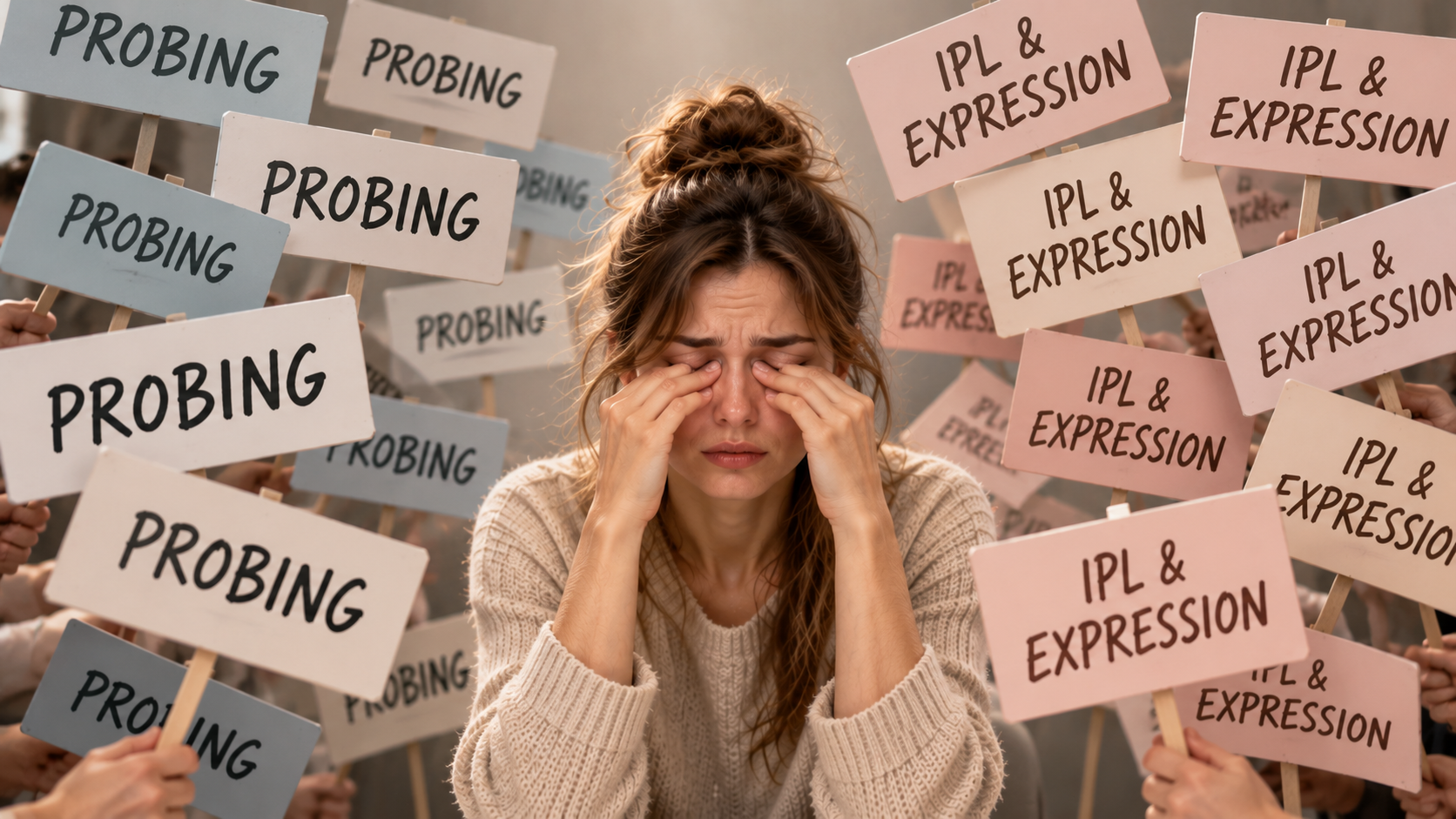
My personal thoughts on MGD treatments, medical responsibility, and why patients should never get lost in the debate.
Probing or IPL with gland expression?
If you've spent enough time in dry eye communities, you've probably noticed that this question can almost divide people into two camps. And I'm not just talking about patients. Sometimes it feels as though doctors themselves have chosen sides.
Some strongly advocate probing. Others favor IPL and gland expression. And occasionally, the discussion starts to sound less like medicine and more like a competition over whose approach is right.
Honestly, that has never made much sense to me.
Because shouldn't the first question be what is actually happening inside a patient's glands, rather than which procedure a doctor happens to believe in?
I understand that doctors develop expertise and preferences. That's perfectly normal. But when those preferences turn into rigid positions, I start to worry about the people caught in the middle.
The patients.
The ones who are already in pain, frightened, confused, and desperately looking for answers.
Same diagnosis. Different problems.
Over the past couple of years, I've spent an unreasonable amount of time reading Facebook groups, Reddit discussions, forums, and pretty much every corner of the internet where people talk about MGD. At some point, researching meibomian glands became something close to a second job. An unpaid one, unfortunately, with terrible working hours.
And I kept noticing the same pattern. Someone would say probing had saved their glands. Someone else would insist that IPL and expression were the answer. Then the discussion would turn into a battle over which treatment was better, which doctor was right, and which procedure everyone should be considering.
But I couldn't stop thinking about one question: Why are we arguing about the best treatment before we've even established what we're treating? The more I learned about MGD, the less sense the idea of one universal solution made to me.
MGD is an umbrella term. Two people can have the same diagnosis, similar symptoms, and even similarly poor tear-film measurements, while the underlying problems may be quite different. For some people, the main issue may be extremely thick, stagnant meibum. Others may have significant inflammation. In some cases, there may be structural changes, narrowing, or fibrotic obstruction within the gland ducts. And of course, several of these problems can exist together.
So why would we automatically assume that the same procedure is the best choice for all of them? Imagine a gland containing very thick secretion. Heat and expression may help release that material. Now imagine a gland where the flow is restricted by something else, such as fibrotic obstruction within the duct. That may require an entirely different discussion, potentially including probing. Of course, it's not always possible to know exactly what's happening inside a gland. Poor expressibility alone doesn't prove fibrosis, and thick meibum doesn't necessarily explain why the problem developed in the first place. But to me, that uncertainty is a reason to investigate more carefully, not to recommend the same procedure to everyone. I don't expect doctors to have all the answers. Medicine is complicated, and MGD is certainly no exception. What I do expect is curiosity. A willingness to look beyond a favorite treatment and ask whether it actually makes sense for the person sitting in front of them.
The Facebook group that didn't want my story
And this brings me to something that happened to me personally.
Some time ago, I shared my MGD recovery story in a Facebook group. I talked about my experience with IPL and gland expression, how my treatment had progressed, and how much my condition had improved. I wasn't promoting a clinic. I wasn't selling anything. I wasn't criticizing probing or telling anyone not to have it. I was simply sharing what had happened to me. People responded. They asked questions. We had a completely normal discussion. And I was happy to answer because I know how much it can mean to hear from someone who has been through severe dry eye and finally started getting better.
Then the next day, I discovered that my post had disappeared. And I had been blocked from the group. I have to admit, I was genuinely surprised. Had I broken some rule? Said something offensive? Accidentally started a revolution in the world of meibomian glands? As far as I could tell, I had done none of those things.
Later, I came to understand that the group was associated with a clinic strongly identified with meibomian gland probing. Now, I don't know exactly why the administrators removed my post or blocked me. And I'm not going to pretend that I do.
But I couldn't help wondering whether my experience simply didn't fit the narrative that was being promoted. And that thought bothered me far more than being blocked.
Because what exactly is the purpose of a patient support group? Isn't it supposed to be a place where people can share their experiences, ask questions, compare different approaches, and support each other? What happens when a patient has a positive experience with a treatment that isn't the group's preferred approach? Does that experience suddenly become less valuable?
I can understand removing misinformation, advertising, harassment, or dangerous medical advice. Absolutely. But sharing a personal recovery story is not the same as prescribing treatment to others. And I find it deeply troubling when a community that patients turn to for support appears to have room for only one particular point of view.
A patient support group should not feel like a marketing department.
When treatment becomes a business
This is probably the part I feel most strongly about. I have absolutely no problem with doctors earning money. They spend years studying, invest in equipment, develop expertise, and take responsibility for their patients. Of course their work should be compensated. But I do have a problem with the possibility that a patient's treatment might be influenced more by what a clinic specializes in, promotes, or profits from than by what that particular patient actually needs. And I think patients have every right to ask uncomfortable questions about that.
When a doctor becomes known for a particular procedure, it's understandable that they believe in it. Especially if they've seen good results. But there is a difference between having confidence in your approach and treating it as the answer to almost everything.
Sometimes I wonder whether we're choosing treatments based on what patients need, or whether patients are being fitted into the treatment packages clinics already offer.
I don't want a doctor to recommend probing simply because probing is what their clinic is known for. And I don't want another doctor to recommend IPL and expression simply because those are the treatments their clinic prefers to offer. I want doctors to look at the actual patient. Their glands. Their symptoms. Their medical history. Their previous treatments. Their risks. Their individual circumstances. And I want them to be willing to say, “You know what? I don't think the procedure we offer is the best option for you.”
Even if that means the patient goes somewhere else. To me, that would inspire far more confidence than another enthusiastic promise about a miracle treatment.
Because we are not talking about choosing between two brands of shampoo. We're talking about people's eyes. Their ability to work, drive, read, go outside, spend time with their families, and simply live without constantly thinking about discomfort. When you've experienced severe dry eye, you know how desperate a person can become. You know what it's like to search for answers at two in the morning, read another success story, and wonder whether this might finally be the thing that saves you. And I believe that desperation creates an enormous responsibility for anyone offering treatment. A patient's suffering should never become an opportunity to sell them a procedure they may not actually need.
What helps one person may harm another
There is another reason I feel so strongly about individualized treatment. Procedures have risks. And those risks are not theoretical when you're the person who experiences a complication. I know that from my own experience with IPL. After eight treatments, I developed an eyelid skin complication that forced me to stop. It was frightening, and some of the changes to my skin persisted. Does that mean IPL is a bad treatment? No.
Does it mean nobody should have it? Of course not. But it reminded me that even a treatment that may benefit many patients can cause problems for someone else. And this is exactly why I find universal recommendations so uncomfortable. Something that helps one person enormously may do very little for another. And in some circumstances, it may cause harm. That's not an argument against probing, IPL, or expression. It's an argument for carefully weighing potential benefits and risks instead of assuming that a successful treatment for one patient must be the right choice for everyone. I would much rather hear a doctor say, “This is why I think this approach may help you, these are the limitations, and these are the risks,” than simply, “This is the best treatment for MGD.”
Because someone else's success story, no matter how encouraging, is not my diagnosis.
I don't want a winner. I want better medicine.
I genuinely hope that probing, IPL, gland expression, and other MGD treatments continue to be studied. I hope we learn much more about which patients benefit from each approach, how to identify different types of obstruction, and how to make treatment safer and more effective. I don't want probing to lose some imaginary competition. I don't want IPL and expression to win it. I want patients to get better.
And I want doctors to remain curious enough to question their own preferred methods.
Because I don't believe a good doctor is someone who has one impressive procedure and recommends it confidently to everyone. I believe a good doctor is someone who understands when that procedure makes sense, when it doesn't, and when the honest answer is that we still don't know.
After everything I've been through, the question I would ask today is no longer simply, “What's the best treatment for MGD?” It is: “What exactly is happening in my glands, and why do you believe this particular treatment is right for me?” Maybe that question won't always have a clear answer. I understand that medicine isn't an exact science. But uncertainty is not a reason to stop thinking critically. And it certainly isn't a reason to turn treatment discussions into marketing battles.
I'm not a doctor. These are my personal observations, questions, and opinions after years of living with MGD. I don't have all the answers, and I'm not pretending to. But I do believe patients deserve individualized treatment, honest information, and the freedom to hear different experiences — even when those experiences don't support someone's favorite procedure.
I don't want doctors to choose sides. I want them to choose what's right for their patients. Because at the end of the day, medicine shouldn't be about proving that your treatment is the best. It should be about finding what's best for the person who came to you for help.
Ana
Dry Eye Diaries
About me