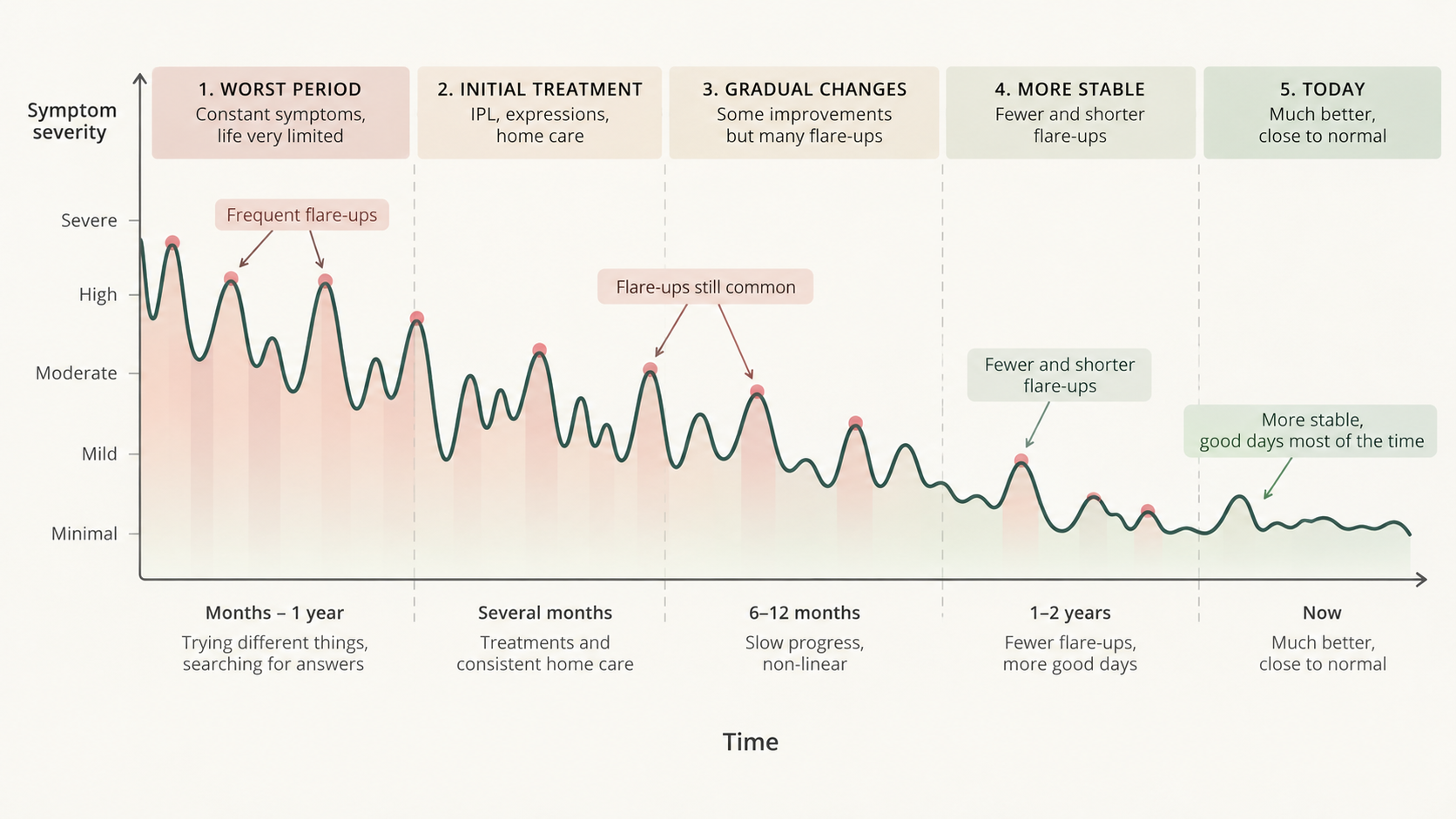
Sometimes I think about how different my life is today compared to just a couple of years ago. I can work on my computer, go shopping, spend time outside, talk to people, and do so many ordinary things without constantly thinking about my eyes. And the funny thing is that most people would never consider any of these things an achievement. Neither would I, before dry eyes became such a huge part of my life.
I'm still not completely symptom-free. I have good days, not-so-good days, and occasional flare-ups. But when I look back at where I started, the difference is enormous. And I think the most surprising thing about my recovery from meibomian gland dysfunction (MGD) is that there was never one treatment, one wonderful day, or one moment when everything suddenly changed. It was a very long process of doing different things, sometimes without even knowing whether they were helping, and slowly getting parts of my life back.
What makes this story even more interesting to me is that some of the things that eventually became helpful would probably have made my symptoms much worse at the beginning. I simply wasn't ready for them yet.
When Dry Eyes Took Over My Life
My MGD didn't appear overnight. At least, I don't think it did. Looking back, I believe my meibomian glands had probably been functioning poorly for years before I noticed anything seriously wrong. By the time my symptoms became impossible to ignore, the oil inside my glands was already extremely thick, and many of them were severely blocked.
And the symptoms were awful. My eyes burned almost constantly. I sometimes woke up at night because of the dryness and needed eye drops just to fall asleep again. Going outside was difficult, shopping was exhausting, and even having a normal conversation could become a problem. I remember talking to someone and feeling my eyes getting more and more uncomfortable until all I wanted was to stop talking and close them.
It's difficult to explain how much something like this can change your life. Dry eyes sound like such a small problem until you experience a severe case yourself. Suddenly, you're planning your entire day around your eyes. You start thinking about where you can go, how long you can stay, whether there will be wind, whether you'll be able to use your phone, and whether you'll manage to get through an ordinary day without too much pain.
I spent an incredible amount of time searching for answers. I read about treatments, watched videos, visited doctors, and tried to understand what was happening. And like so many people with chronic dry eyes, I kept hoping that somewhere there was something I hadn't tried yet that would finally make everything better.
Why One Treatment Wasn't Enough
At the beginning, I tried warm compresses at home. A lot of them. Heat was one of the few things that gave me temporary relief, so naturally I thought that if I kept doing it, my glands would eventually start working normally again.
But they didn't.
After seeing several doctors, I eventually found a dry eye specialist who examined my meibomian glands more closely. My meibography showed that I still had many glands, although there was some gland loss. But when my doctor tried to express them, almost nothing came out. The meibum was so thick that even applying pressure barely helped.
That was when I began to understand how serious the blockage had become. We started IPL treatments combined with gland expression. I eventually had eight IPL sessions and continued with expressions afterwards, even after I had to stop IPL because of an eyelid skin injury.
And the whole process was incredibly slow. At first, we could barely get anything out. Later, small amounts of thick, toothpaste-like material started appearing. Gradually, the secretion became softer, and eventually we began seeing something much closer to normal oil.
It took many appointments, a lot of patience, and plenty of moments when I wondered whether any of this was actually working.
Looking back, I think this was the first important stage of my recovery. My glands were so badly obstructed that simply trying to stimulate them at home wasn't enough for me. I needed professional help to gradually deal with the material that wasn't coming out.
Of course, I can't say exactly how much each treatment contributed. IPL and expression were initially done together, and I was also doing warm compresses at home. But one thing I could see was that the condition of the meibum was slowly changing.
And that became important later.
The Things That Help Me Today Would Have Been Impossible Back Then
Here's something I've been thinking about a lot.
Today, spending time outside often seems to help my eyes. But during the worst period of my MGD, going outside was one of the things I tried to avoid. Wind, moving air, changes in temperature — almost everything made my eyes feel worse. If someone had told me back then to spend more time outdoors to improve my dry eyes, I probably would have thought they had absolutely no idea what I was going through.
But after many months of treatment, when my glands had started producing softer meibum and my symptoms had become a little more manageable, I noticed something interesting.
We had moved from an apartment to a house, and I began spending much more time outside. At first, it wasn't always comfortable. Sometimes my eyes felt drier or more irritated afterwards. But over the following weeks and months, I noticed that I could do more. I could spend longer on my computer, concentrate better, and tolerate activities that had previously been almost impossible.
My personal impression was that spending time outside somehow encouraged my glands to release oil more regularly. I don't know exactly why, and I certainly can't prove that being outdoors was responsible for the improvement. But it became one of the things I associated with feeling better over time.
And then there was the fireplace.
During winter, our house was often cold, and I spent a lot of time sitting near the fire. I began noticing that the warmth seemed to make my eyes feel oilier afterwards. Sometimes I could even see more lipid spreading across the surface when I blinked.
Interestingly, I didn't always feel better immediately. Occasionally, I felt a little drier or more irritated afterwards. But over time, I became less interested in judging everything by how my eyes felt during the next hour and more interested in whether I was gradually becoming more comfortable in everyday life.
I wouldn't recommend sitting close to a fireplace as a dry eye treatment, especially because heat, smoke, and dry air can irritate the eyes. I'm simply describing what I noticed in my own situation.
And this is where I started to see my recovery differently.
Maybe some of the things I was doing later became more useful because my glands were no longer in the same condition they had been at the beginning. Maybe the gradual changes in the meibum made it easier for normal blinking, warmth, and everyday activities to help move the oil.
That's my interpretation, not something I can prove. But it makes sense of an experience that otherwise seemed very strange: something I could barely tolerate at the beginning eventually became part of my everyday routine.
Learning to See Progress Differently
One of the hardest things about recovering from MGD was that improvement never happened in a nice, predictable way.
I would have a few better days and start getting excited. Then suddenly my eyes would feel worse again, and I'd wonder whether I had lost all my progress. Sometimes the changes were so small that I couldn't even tell whether I was improving.
For a while, I kept a journal. Every day I wrote down how my eyes felt, hoping that if I collected enough information, I'd finally see a clear pattern. But after about six months, I realized that constantly analyzing every symptom was becoming exhausting.
So I changed the way I measured progress.
Instead of asking myself how dry my eyes felt today compared to yesterday, I started asking what I could actually do.
Could I spend an hour on my computer without needing a break? Could I go to the supermarket? Could I have a long conversation? Could I go outside without worrying about my eyes the entire time?
These were things I could remember much more clearly than whether my discomfort had been a four or a six on some particular day.
And slowly, the answers started changing.
Maybe one week I could work for two hours, then I'd have a flare-up and struggle again. But a month later, I might be able to work for three hours. And a few months after that, I might stop thinking about my eyes while working altogether.
That was real progress, even when individual days didn't feel particularly good.
I think this shift in perspective helped me enormously. Not because it made my symptoms disappear, but because it allowed me to see that a bad day didn't necessarily mean I was back where I started.
Where I Am Today
After more than two and a half years of living with MGD, I still have some symptoms. My eyes aren't perfect, and I don't know whether they'll ever be completely symptom-free.
But my life is so different now.
I can do things that once felt completely out of reach. I can spend time outside, work, go places, and enjoy ordinary moments without my eyes constantly demanding my attention. There are still days when I feel more dryness or irritation, but those days no longer define my entire life.
And when I think about what helped me, I don't think of one miracle treatment.
I think of a series of steps.
First, finding someone who could help me understand what was happening inside my glands. Then gradually dealing with the severe obstruction. Continuing my home routine. Paying attention to how my eyes responded to different activities. Learning what I could tolerate at each stage. And, perhaps most importantly, giving the process enough time to see whether the overall direction was changing.
Not everything I tried necessarily helped, and I can't separate the effects of every treatment or habit. But I believe that the combination of consistent care, gradual changes in my glands, and adapting my routine as my condition improved played an important role in my recovery.
The biggest lesson for me is that recovery isn't always about finding one thing that works. Sometimes it's about understanding what your body needs at different stages.
Something that isn't helpful today might become useful later. Something that gives immediate relief might not be enough to address the underlying problem. And sometimes you can be improving even when you don't feel better every single day.
I know that my experience won't apply to everyone with MGD. There are different causes, different degrees of gland damage, and different reasons why people develop dry eyes. I was fortunate that many of my glands were still present, even though they were severely obstructed.
But I remember how desperately I searched for stories of people who had improved. Not necessarily people who were completely cured. Just someone who could tell me that life could become more manageable again.
And that's why I wanted to share mine.
I'm not where I was before dry eyes. But I'm also nowhere near where I was at my worst. And for now, that's something I'm genuinely grateful for.
Ana
Dry Eye Diaries
About me